How to Choose the Right Diving Magnet for Commercial Diving
A practical buying guide covering pull force ratings, sizing, and real-world selection criteria for professional commercial diving magnets — from light inspection work to heavy-duty offshore operations.
<h2>Key Takeaway</h2>
<p>Choosing the right diving magnet comes down to matching pull force to your operational needs. For light inspection and recreational use, 115–140 kg models work well. For standard commercial diving tasks, 160–280 kg magnets offer the best balance of power and portability. For heavy-duty offshore anchoring, 320–500 kg models deliver the sustained holding force that demanding subsea operations require.</p>
<h2>Why Pull Force Matters More Than Size</h2>
<p>The single most important specification when selecting a <a href="/en/category/diver-magnets">diver magnet</a> is its rated pull force — measured in kilograms on a smooth 10 mm polished steel plate at 20°C under 100% surface contact. This number tells you the maximum static holding power under ideal conditions.</p>
<p>However, real-world subsea conditions are never ideal. Factors like marine growth, paint, rust, curved surfaces, current, and temperature all reduce effective holding power. A good rule of thumb: select a magnet with 2–3× the pull force you think you'll need.</p>
<h2>Magnet Tiers by Application</h2>
<h3>Light Duty: 115–140 kg Pull Force</h3>
<p>The <a href="/en/products/diver-magnet-115">Diver Magnet - 115</a> and <a href="/en/products/diver-magnet-140">Diver Magnet - 140</a> are ideal entry-level magnets for:</p>
<ul>
<li>Hull surveys and visual inspections</li>
<li>Light maintenance work near steel structures</li>
<li>Recreational diving tool holding</li>
<li>Situations where compact size and low weight are priorities</li>
</ul>
<p>These models provide reliable holding power while remaining easy to attach and detach with one hand.</p>
<h3>Standard Commercial: 160–280 kg Pull Force</h3>
<p>The mid-range models — <a href="/en/products/diver-magnet-160">Diver Magnet - 160</a>, <a href="/en/products/diver-magnet-200">Diver Magnet - 200</a>, <a href="/en/products/diver-magnet-230">Diver Magnet - 230</a>, <a href="/en/products/diver-magnet-250">Diver Magnet - 250</a>, and <a href="/en/products/diver-magnet-280">Diver Magnet - 280</a> — are the workhorses of the commercial diving industry. They cover:</p>
<ul>
<li>Offshore pipeline inspection and maintenance</li>
<li>Ship hull cleaning and underwater welding</li>
<li>Subsea construction support</li>
<li>UWILD (Underwater In-Lieu of Drydocking) surveys</li>
</ul>
<p>The <a href="/en/products/diver-magnet-200">Diver Magnet - 200</a> and <a href="/en/products/diver-magnet-250">Diver Magnet - 250</a> are particularly popular because they strike an excellent balance between holding power and operational flexibility.</p>
<h3>Heavy Duty: 320–500 kg Pull Force</h3>
<p>For the most demanding subsea operations, the <a href="/en/products/diver-magnet-320">Diver Magnet - 320</a>, <a href="/en/products/diver-magnet-400">Diver Magnet - 400</a>, and <a href="/en/products/diver-magnet-500">Diver Magnet - 500</a> deliver exceptional holding power. These are designed for:</p>
<ul>
<li>Heavy-duty anchoring in strong currents</li>
<li>Extended work periods on large steel structures</li>
<li>Tool staging and equipment positioning</li>
<li>Operations where failure is not an option</li>
</ul>
<h2>What Makes a Diver Magnet Different from a Standard Magnet?</h2>
<p>Standard <a href="/en/category/pot-magnets">pot magnets</a> and <a href="/en/category/hook-magnets">hook magnets</a> are not designed for underwater use. Our Diver Magnets are purpose-built for subsea environments with:</p>
<ul>
<li><strong>Epoxy-polyethylene coating</strong> — prevents saltwater corrosion and protects the neodymium core</li>
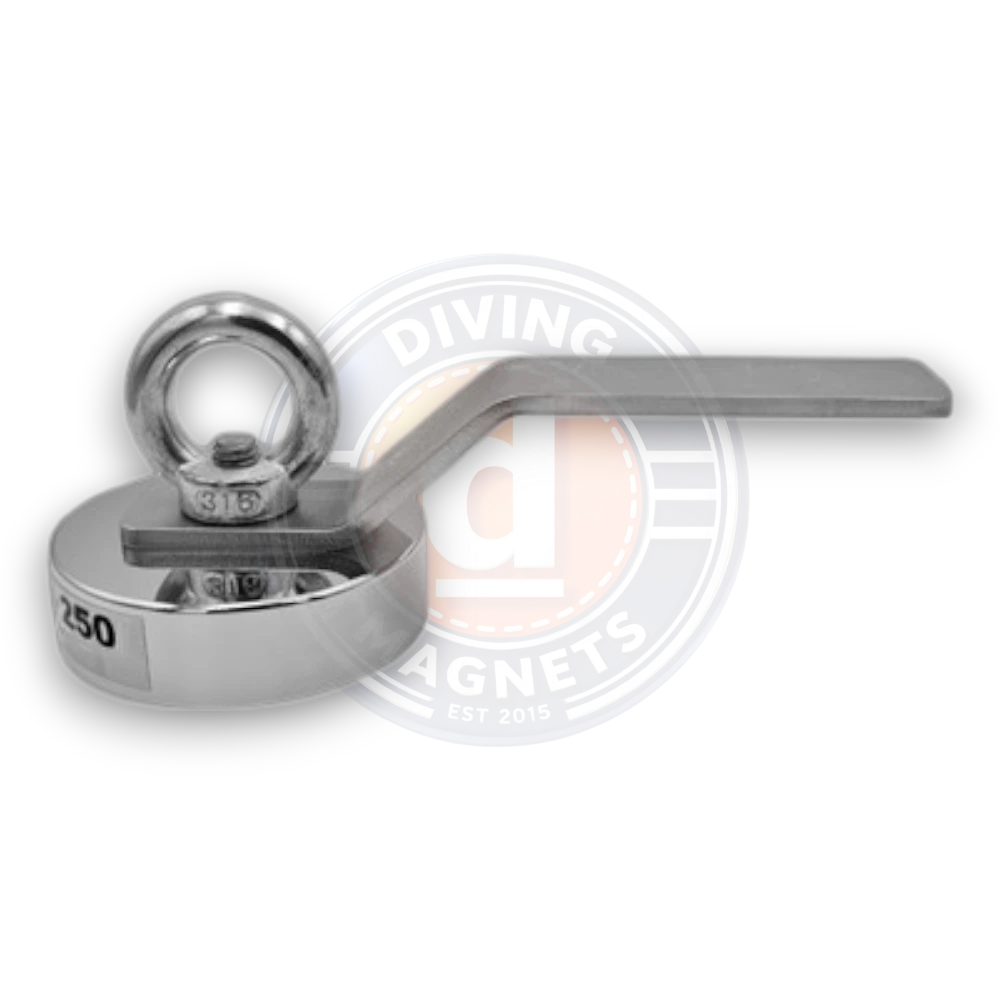
<li><strong>316 stainless steel eyebolt and handle</strong> — marine-grade hardware that won't corrode</li>
<li><strong>Reinforced housing</strong> — AISI A3 steel pot designed to withstand impacts and rough handling</li>
<li><strong>Ergonomic design</strong> — handle allows controlled one-handed attachment and detachment underwater</li>
</ul>
<h2>Practical Selection Checklist</h2>
<p>Before choosing your magnet, consider these factors:</p>
<ol>
<li><strong>What surface will you attach to?</strong> Smooth, clean steel gives full rated pull force. Painted, rusty, or curved surfaces reduce it significantly.</li>
<li><strong>What current conditions do you work in?</strong> Stronger currents mean you need more holding power.</li>
<li><strong>How long will you be attached?</strong> Extended operations benefit from higher pull force for safety margins.</li>
<li><strong>What is your weight and equipment load?</strong> Heavier divers with more gear need stronger magnets.</li>
<li><strong>Do you need one-handed operation?</strong> All our models feature a handle for controlled attachment, but larger magnets require more effort to detach.</li>
</ol>
<h2>Pair Your Magnet with the Right Accessories</h2>
<p>For optimal safety, pair your diving magnet with a <a href="/en/category/accessories">Diver Magnet Lanyard</a>. This prevents accidental magnet loss and keeps it secured to your BCD or harness at all times.</p>
<p>Still unsure which model is right for your operation? Visit our <a href="/en/compare">magnet comparison page</a> to see all models side by side, or browse our complete <a href="/en/category/diver-magnets">Diver Magnet range</a>.</p>