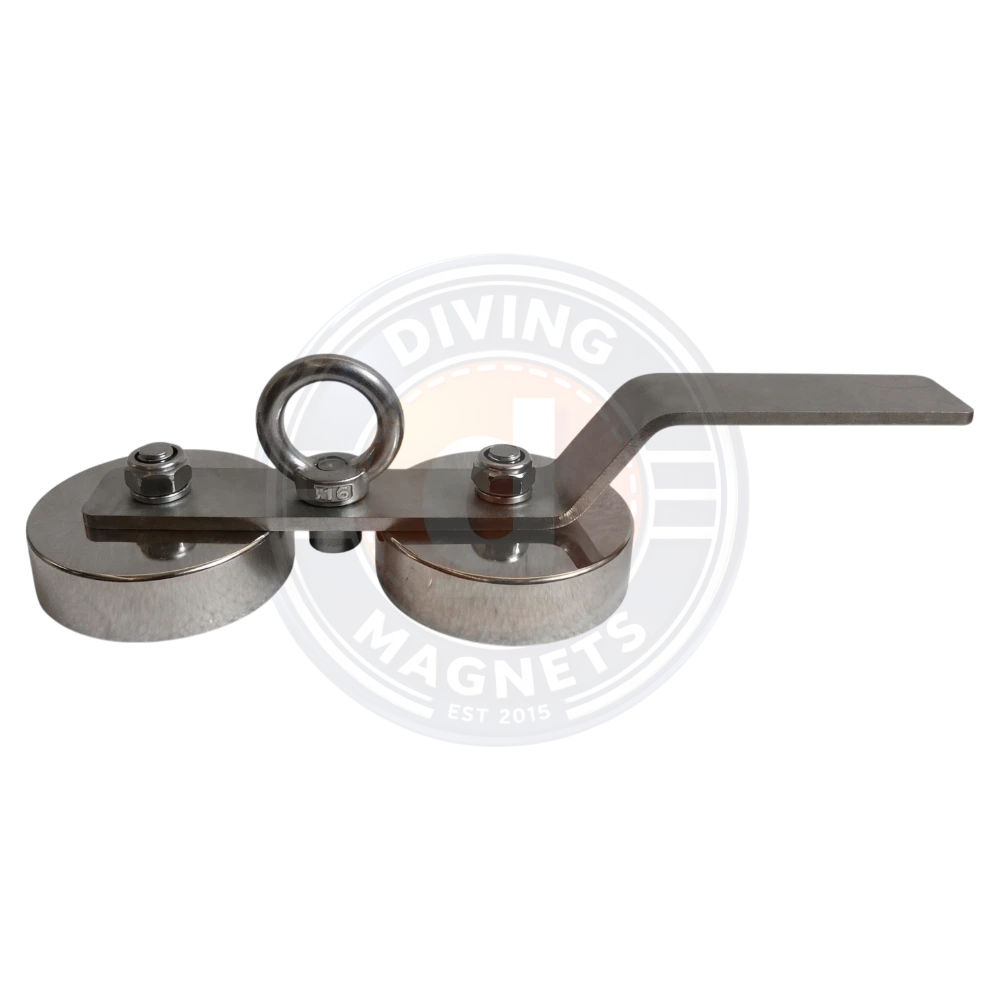
Magnet Pull Force Explained: What Affects Real-World Holding Power Underwater
A technical explainer on how magnet pull force is rated, why real-world subsea performance differs from lab values, and what factors — surface condition, temperature, air gaps, and pull angle — affect actual holding power.
<h2>Key Takeaway</h2>
<p>Pull force ratings tell you the maximum holding power under ideal laboratory conditions: a smooth, 10 mm thick polished steel plate at 20°C with 100% surface contact. In real-world subsea conditions — where surfaces are painted, corroded, curved, or covered in marine growth — actual holding power can be 30–70% lower than the rated value. Understanding these derating factors is essential for selecting the right <a href="/en/category/diver-magnets">diving magnet</a> and using it safely.</p>
<h2>How Pull Force is Measured</h2>
<p>Pull force is the perpendicular force required to detach a magnet from a ferromagnetic surface under controlled conditions. The standard test protocol for our magnets involves:</p>
<ul>
<li><strong>Test surface:</strong> 10 mm thick polished low-carbon steel plate</li>
<li><strong>Surface finish:</strong> Smooth, clean, degreased — no paint, rust, or coatings</li>
<li><strong>Temperature:</strong> 20°C (68°F)</li>
<li><strong>Contact:</strong> 100% face contact — magnet sits perfectly flat on the surface</li>
<li><strong>Pull direction:</strong> Perpendicular (straight away from the surface)</li>
</ul>
<p>Under these conditions, our <a href="/en/products/diver-magnet-250">Diver Magnet - 250</a> delivers a rated pull force of 250 kg. But no underwater surface matches these laboratory conditions.</p>
<h2>Pull Force Ratings Across Our Range</h2>
<p>Our diver magnets span a wide range of pull force ratings, each with detailed specifications available on the product page:</p>
<ul>
<li><a href="/en/products/diver-magnet-115">Diver Magnet - 115</a> — 115 kg rated pull force</li>
<li><a href="/en/products/diver-magnet-140">Diver Magnet - 140</a> — 140 kg rated pull force</li>
<li><a href="/en/products/diver-magnet-160">Diver Magnet - 160</a> — 160 kg rated pull force</li>
<li><a href="/en/products/diver-magnet-200">Diver Magnet - 200</a> — 200 kg rated pull force</li>
<li><a href="/en/products/diver-magnet-230">Diver Magnet - 230</a> — 230 kg rated pull force</li>
<li><a href="/en/products/diver-magnet-250">Diver Magnet - 250</a> — 250 kg rated pull force</li>
<li><a href="/en/products/diver-magnet-280">Diver Magnet - 280</a> — 280 kg rated pull force</li>
<li><a href="/en/products/diver-magnet-320">Diver Magnet - 320</a> — 320 kg rated pull force</li>
<li><a href="/en/products/diver-magnet-400">Diver Magnet - 400</a> — 400 kg rated pull force</li>
<li><a href="/en/products/diver-magnet-500">Diver Magnet - 500</a> — 500 kg rated pull force</li>
</ul>
<p>Each product page includes the full technical specification — magnet grade (N42–N48), coating type, housing material, eyebolt rating, and dimensions. Visit any product page to see detailed specs.</p>
<h2>Factor 1: Surface Condition</h2>
<p>This is the single largest factor affecting real-world pull force. The condition of the metal surface determines how much of the magnet's face makes effective contact:</p>
<ul>
<li><strong>Paint and coatings:</strong> Each layer of paint creates a non-magnetic gap between the magnet and the steel. One layer of marine paint can reduce pull force by 15–25%</li>
<li><strong>Rust and corrosion:</strong> Iron oxide is significantly less magnetically permeable than clean steel. Heavy corrosion can reduce pull force by 30–50%</li>
<li><strong>Marine growth:</strong> Barnacles, mussels, and algae create physical barriers. Even thin biofilm reduces surface contact</li>
<li><strong>Surface roughness:</strong> Rough or pitted surfaces reduce the contact area, creating effective air gaps across the face</li>
</ul>
<p><strong>Practical implication:</strong> On a painted ship hull with moderate marine growth, expect 40–60% of the rated pull force. On heavily corroded structures, this can drop to 30% or less.</p>
<h2>Factor 2: Air Gaps</h2>
<p>Magnetic force drops exponentially with distance. Even a tiny gap between the magnet face and the steel surface causes dramatic reduction in pull force:</p>
<ul>
<li><strong>0.5 mm gap:</strong> Pull force reduced by approximately 50%</li>
<li><strong>1.0 mm gap:</strong> Pull force reduced by approximately 70%</li>
<li><strong>2.0 mm gap:</strong> Pull force reduced by approximately 85%</li>
</ul>
<p>Air gaps are created by surface irregularities, paint buildup, trapped debris, and curved surfaces where the flat magnet face cannot achieve full contact.</p>
<h2>Factor 3: Material Thickness</h2>
<p>The magnetic circuit requires sufficient ferromagnetic material to carry the flux. If the steel plate or structure is too thin, the magnetic field cannot fully close through the material, reducing pull force:</p>
<ul>
<li><strong>10 mm+ steel:</strong> Full rated pull force</li>
<li><strong>5 mm steel:</strong> Approximately 80% of rated force</li>
<li><strong>3 mm steel:</strong> Approximately 60% of rated force</li>
<li><strong>1 mm steel:</strong> Approximately 30% of rated force</li>
</ul>
<p>Ship hulls (typically 12–25 mm) and heavy structural steel provide more than adequate thickness. Thin-walled piping, sheet metal, and lightweight structures may not.</p>
<h2>Factor 4: Temperature</h2>
<p>Neodymium magnets lose strength as temperature increases. The maximum operating temperature for our N42–N48 grade magnets is approximately 80°C (176°F). In practice:</p>
<ul>
<li><strong>Below 20°C (typical subsea):</strong> Pull force is slightly <em>higher</em> than the rated value — cold water is an advantage</li>
<li><strong>20–40°C:</strong> Negligible change</li>
<li><strong>40–60°C:</strong> Pull force decreases by 5–10%</li>
<li><strong>Above 60°C:</strong> Significant and potentially irreversible loss of magnetic strength</li>
</ul>
<p>For most underwater operations, temperature works in the diver's favour — cold seawater keeps the magnet below its rated temperature.</p>
<h2>Factor 5: Pull Direction and Angle</h2>
<p>The rated pull force assumes a perpendicular (straight) pull away from the surface. Pulling at an angle, or applying lateral (sliding) force, significantly reduces effective holding power:</p>
<ul>
<li><strong>Perpendicular pull:</strong> 100% of rated force required to detach</li>
<li><strong>45° angle pull:</strong> Approximately 50% of rated force needed</li>
<li><strong>Lateral (shear) force:</strong> Only 15–30% of perpendicular force needed to slide the magnet</li>
</ul>
<p>This is why current direction matters. A diver anchored to a hull with a strong cross-current is experiencing lateral force on the magnet, which is much easier to overcome than a perpendicular load.</p>
<h2>Safety Factor Recommendations</h2>
<p>Given all these derating factors, we recommend selecting a magnet with 2–3× the pull force you estimate needing for your specific conditions:</p>
<ul>
<li><strong>Clean, smooth steel in calm water:</strong> 1.5× safety factor</li>
<li><strong>Painted hull in moderate current:</strong> 2× safety factor</li>
<li><strong>Corroded structure in strong current:</strong> 3× safety factor</li>
</ul>
<p>Use our <a href="/en/compare">comparison page</a> to evaluate all models and their specifications side by side, or read our <a href="/en/articles/how-to-choose-the-right-diving-magnet-for-commercial-diving">buying guide</a> for application-specific recommendations. For comprehensive product specifications including dimensions, weight, and material details, browse our full <a href="/en/category/diver-magnets">Diver Magnet range</a>.</p>