Subsea Magnet Coatings: How Epoxy and Polyethylene Protect Against Corrosion
Learn why neodymium magnets corrode in saltwater and how specialised epoxy-polyethylene coatings protect commercial diving magnets from oxidation, demagnetisation, and structural failure.
<h2>Key Takeaway</h2>
<p>Neodymium magnets are inherently vulnerable to corrosion — particularly in saltwater environments. Without proper protection, the iron content in NdFeB (neodymium-iron-boron) alloy oxidises rapidly, causing irreversible loss of magnetic strength and structural deterioration. Our diver magnets use a multi-layer epoxy-polyethylene coating system specifically engineered to provide a durable barrier against saltwater, pressure, abrasion, and UV exposure.</p>
<h2>Why Neodymium Magnets Corrode</h2>
<p>Neodymium magnets are made from an alloy of neodymium, iron, and boron (NdFeB). The iron component — which makes up approximately 65% of the alloy by weight — is highly susceptible to oxidation when exposed to moisture. In saltwater, the corrosion process accelerates dramatically due to the electrolytic properties of dissolved salts.</p>
<p>When corrosion occurs, it does not just affect the surface. Oxidation penetrates through the grain boundaries of the sintered magnet material, causing:</p>
<ul>
<li><strong>Loss of magnetic strength:</strong> Oxidised regions lose their magnetic alignment permanently</li>
<li><strong>Structural crumbling:</strong> Corroded magnets become brittle and can fragment</li>
<li><strong>Coating failure cascade:</strong> Once a coating is breached, corrosion spreads rapidly beneath the surface</li>
</ul>
<h2>Standard Coatings vs Marine-Grade Coatings</h2>
<p>Most commercial neodymium magnets — including standard <a href="/en/category/pot-magnets">pot magnets</a> and <a href="/en/category/hook-magnets">hook magnets</a> — use a thin nickel or zinc plating. These coatings provide adequate protection for dry indoor environments but fail rapidly in marine conditions:</p>
<ul>
<li><strong>Nickel plating (10–15 µm):</strong> Offers basic scratch resistance but is porous at the microscopic level; salt spray penetrates within weeks</li>
<li><strong>Zinc plating (8–12 µm):</strong> Provides sacrificial corrosion protection but dissolves quickly in saltwater</li>
<li><strong>Epoxy-only coating (15–25 µm):</strong> Better moisture barrier, but brittle and prone to chipping on impact</li>
</ul>
<h2>The Epoxy-Polyethylene Coating System</h2>
<p>Our <a href="/en/category/diver-magnets">diver magnets</a> use a multi-layer epoxy-polyethylene coating system designed specifically for prolonged saltwater immersion. You can see the coating specifications listed on each product page — for example, the <a href="/en/products/diver-magnet-250">Diver Magnet - 250</a> specifies N42–N48 grade NdFeB with epoxy-polyethylene coating at 15–20 microns thickness.</p>
<ol>
<li><strong>Surface preparation:</strong> The NdFeB magnet is cleaned, degreased, and acid-etched to create a microscopically rough surface for maximum coating adhesion</li>
<li><strong>Epoxy primer layer:</strong> A chemical-resistant epoxy is applied as the primary moisture barrier, bonding directly to the prepared neodymium surface</li>
<li><strong>Polyethylene outer layer:</strong> A tough, flexible polyethylene coating is applied over the epoxy, providing mechanical protection against impact, abrasion, and UV degradation</li>
</ol>
<p>The combined coating thickness of 15–20 microns creates a continuous, pinhole-free barrier that prevents saltwater from reaching the magnet core.</p>
<h3>Why Two Layers?</h3>
<p>Each layer serves a distinct purpose:</p>
<ul>
<li><strong>Epoxy</strong> provides excellent chemical resistance and adhesion to the magnet surface, but is relatively brittle and can crack under impact</li>
<li><strong>Polyethylene</strong> provides flexibility, impact resistance, and UV stability, but does not bond as well directly to neodymium</li>
</ul>
<p>Together, they create a coating system that is both chemically resistant and mechanically durable — essential for the demanding conditions of commercial diving operations.</p>
<h2>Coating Specs Across Our Diver Magnet Range</h2>
<p>Every model in our range — from the compact <a href="/en/products/diver-magnet-115">Diver Magnet - 115</a> to the heavy-duty <a href="/en/products/diver-magnet-500">Diver Magnet - 500</a> — uses the same marine-grade epoxy-polyethylene coating system. The key material specifications are consistent across all models:</p>
<ul>
<li><strong>Magnet grade:</strong> N42 to N48 High Performance NdFeB</li>
<li><strong>Coating:</strong> Epoxy-polyethylene, 15–20 microns</li>
<li><strong>Magnetisation:</strong> Axial (through thickness)</li>
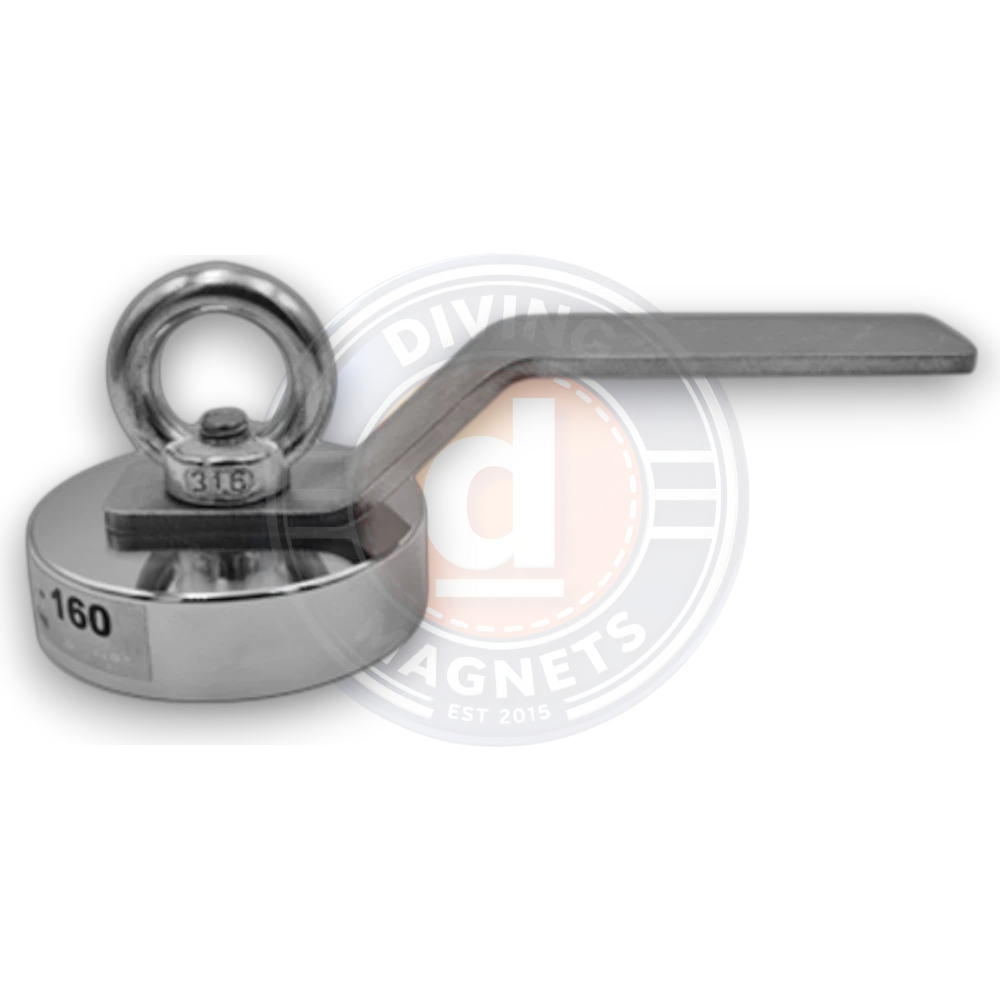
<li><strong>Eyebolt & handle:</strong> 316 stainless steel</li>
<li><strong>Housing:</strong> AISI A3 steel</li>
</ul>
<p>You can verify these specifications on each product's detail page. Visit the <a href="/en/products/diver-magnet-200">Diver Magnet - 200</a> or <a href="/en/products/diver-magnet-320">Diver Magnet - 320</a> for representative examples, or compare all models side by side on our <a href="/en/compare">comparison page</a>.</p>
<h2>Marine-Grade Hardware</h2>
<p>Coating the magnet alone is not enough. Every metal component that contacts saltwater must also be corrosion-resistant. Our diver magnets use:</p>
<ul>
<li><strong>316 stainless steel eyebolt:</strong> The most corrosion-resistant common stainless steel grade, rated for continuous marine exposure</li>
<li><strong>316 stainless steel handle:</strong> Provides controlled attachment and detachment without exposing unprotected metal</li>
<li><strong>AISI A3 steel housing:</strong> Protected within the coating system, designed to concentrate magnetic flux while resisting deformation</li>
</ul>
<h2>Maintenance Best Practices</h2>
<p>Even with marine-grade coatings, proper care extends the lifespan of your diving magnet significantly:</p>
<ol>
<li><strong>Rinse after every dive:</strong> Fresh water removes salt crystals that can gradually degrade the coating surface</li>
<li><strong>Inspect the coating regularly:</strong> Look for chips, scratches, or wear that could allow moisture ingress</li>
<li><strong>Store dry:</strong> Keep magnets in a low-humidity environment between uses</li>
<li><strong>Remove iron filings:</strong> Small metal particles trapped on the surface can create scratches that damage the coating over time</li>
<li><strong>Avoid impacts:</strong> Do not drop magnets onto hard surfaces — impacts can crack the coating and damage the neodymium core</li>
</ol>
<p>For more maintenance and safety guidance, read our <a href="/en/articles/essential-safety-rules-neodymium-magnets-underwater">safety rules for neodymium magnets</a> or visit our <a href="/en/faq">FAQ page</a>.</p>