Technical
Specifications
Detailed engineering specifications for professional-grade diving magnets
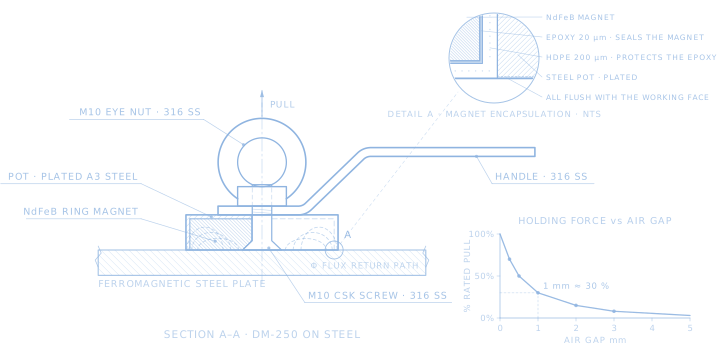
Specification Table
This table covers the 5 single Diving Magnets diver magnets (115–250 kg pull force, N42–N48 neodymium, Epoxy-HDPE sealed, proven to 150 m). The twin magnets (230–500 kg) are in the assembled dimensions table below.

NdFeB · all models · layers not to scale
| Model | Attraction | D | D1 | D2 | H | Grade | Magnet only (g) | Slide | Fixing | Technical drawing |
|---|---|---|---|---|---|---|---|---|---|---|
| kg | mm | mm | mm | mm | kg | |||||
| Ø60 mm pot | ||||||||||
| DMS115-CS/P | 115 | 60 | 8.5 | 16.5 | 21 | N42 | 388 | 23 | 8mm c/s screw | Drawing |
| DMS140-CS/P | 140 | 60 | 8.5 | 16.5 | 21 | N48 | 388 | 28 | 8mm c/s screw | Drawing |
| Ø78 mm pot | ||||||||||
| DMS160-CS/P | 160 | 78 | 10.5 | 20.5 | 18 | N42 | 475 | 32 | 10mm c/s screw | Drawing |
| DMS200-CS/P | 200 | 78 | 10.5 | 20.5 | 18 | N45 | 475 | 40 | 10mm c/s screw | Drawing |
| DMS250-CS/P | 250 | 78 | 10.5 | 20.5 | 18 | N48 | 590 | 50 | 10mm c/s screw | Drawing |
DMS115-CS/PØ60 mm pot
- Attraction
- 115 kg
- D
- 60 mm
- D1
- 8.5 mm
- D2
- 16.5 mm
- H
- 21 mm
- Grade
- N42
- Magnet only (g)
- 388
- Slide
- 23 kg
- Fixing
- 8mm c/s screw
DMS140-CS/PØ60 mm pot
- Attraction
- 140 kg
- D
- 60 mm
- D1
- 8.5 mm
- D2
- 16.5 mm
- H
- 21 mm
- Grade
- N48
- Magnet only (g)
- 388
- Slide
- 28 kg
- Fixing
- 8mm c/s screw
DMS160-CS/PØ78 mm pot
- Attraction
- 160 kg
- D
- 78 mm
- D1
- 10.5 mm
- D2
- 20.5 mm
- H
- 18 mm
- Grade
- N42
- Magnet only (g)
- 475
- Slide
- 32 kg
- Fixing
- 10mm c/s screw
DMS200-CS/PØ78 mm pot
- Attraction
- 200 kg
- D
- 78 mm
- D1
- 10.5 mm
- D2
- 20.5 mm
- H
- 18 mm
- Grade
- N45
- Magnet only (g)
- 475
- Slide
- 40 kg
- Fixing
- 10mm c/s screw
DMS250-CS/PØ78 mm pot
- Attraction
- 250 kg
- D
- 78 mm
- D1
- 10.5 mm
- D2
- 20.5 mm
- H
- 18 mm
- Grade
- N48
- Magnet only (g)
- 590
- Slide
- 50 kg
- Fixing
- 10mm c/s screw
Assembled dimensions (mm)
| Model | Build | Length | Width | Height |
|---|---|---|---|---|
| DM-115, DM-140 | 1 × Ø60 magnet, M8 eye nut | 170 | 60 | 61.5 |
| DM-160, DM-200, DM-250 | 1 × Ø78 magnet, M10 eye nut | 179 | 78 | 67.5 |
| DM-230, DM-280 | 2 × Ø60 magnets, M8 eye nut | 235.5 | 60 | 61.5 |
| DM-320, DM-400, DM-500 | 2 × Ø78 magnets, M10 eye nut | 289 | 78 | 67.5 |
DM-115, DM-140
- Build
- 1 × Ø60 magnet, M8 eye nut
- Length
- 170
- Width
- 60
- Height
- 61.5
DM-160, DM-200, DM-250
- Build
- 1 × Ø78 magnet, M10 eye nut
- Length
- 179
- Width
- 78
- Height
- 67.5
DM-230, DM-280
- Build
- 2 × Ø60 magnets, M8 eye nut
- Length
- 235.5
- Width
- 60
- Height
- 61.5
DM-320, DM-400, DM-500
- Build
- 2 × Ø78 magnets, M10 eye nut
- Length
- 289
- Width
- 78
- Height
- 67.5
Height includes the eye nut.
Find your model
Choose a Diver Magnet to see its technical drawing. Dimensions in mm; eye nut per DIN 582.
Note: All specifications are subject to standard tolerances. For detailed dimensional drawings and technical consultation, please contact our sales team. Performance characteristics may vary based on application conditions and surface preparation.
Neodymium Magnet
Steel Housing
Eye Nut and Handle
Application
Professional-grade diving magnets with counter-bored hole design for secure fastening
Understanding Pull Force
Factors Affecting Performance
- Surface Condition: Rust, paint or marine growth between the magnet and the surface reduces pull force
- Material Thickness: Thin metal (under 5mm) reduces effective pull force
- Air Gaps: Even a thin gap (paint, growth, rust) reduces pull force, often a lot
- Temperature: Higher temperatures reduce magnetic strength
- Pull Angle: Side-loading or an angled pull reduces holding force, often a lot
Real-World Considerations
Choosing the right capacity
Choose a magnet whose rated pull force is at least 2–3× the holding load you need — more for dynamic, angled or vibrating loads. Rated pull is measured under ideal conditions; actual holding force depends on surface condition, contact area, coating and paint, and the direction of the load. Diving magnets are positioning and holding tools, not lifting equipment.
- Underwater: Current and wave action create additional forces
- Curved Surfaces: Reduce contact area and thus pull force
- Non-Ferrous Metals: Aluminum, brass, copper are non-magnetic
- Stainless Steel: Austenitic grades (304, 316) show little or no attraction — slightly magnetic only where cold-worked or welded
Ready to Select the Right Model?
Browse our full range of Diver Magnets and find the right pull force for your operation.
Shop Diving MagnetsLast updated