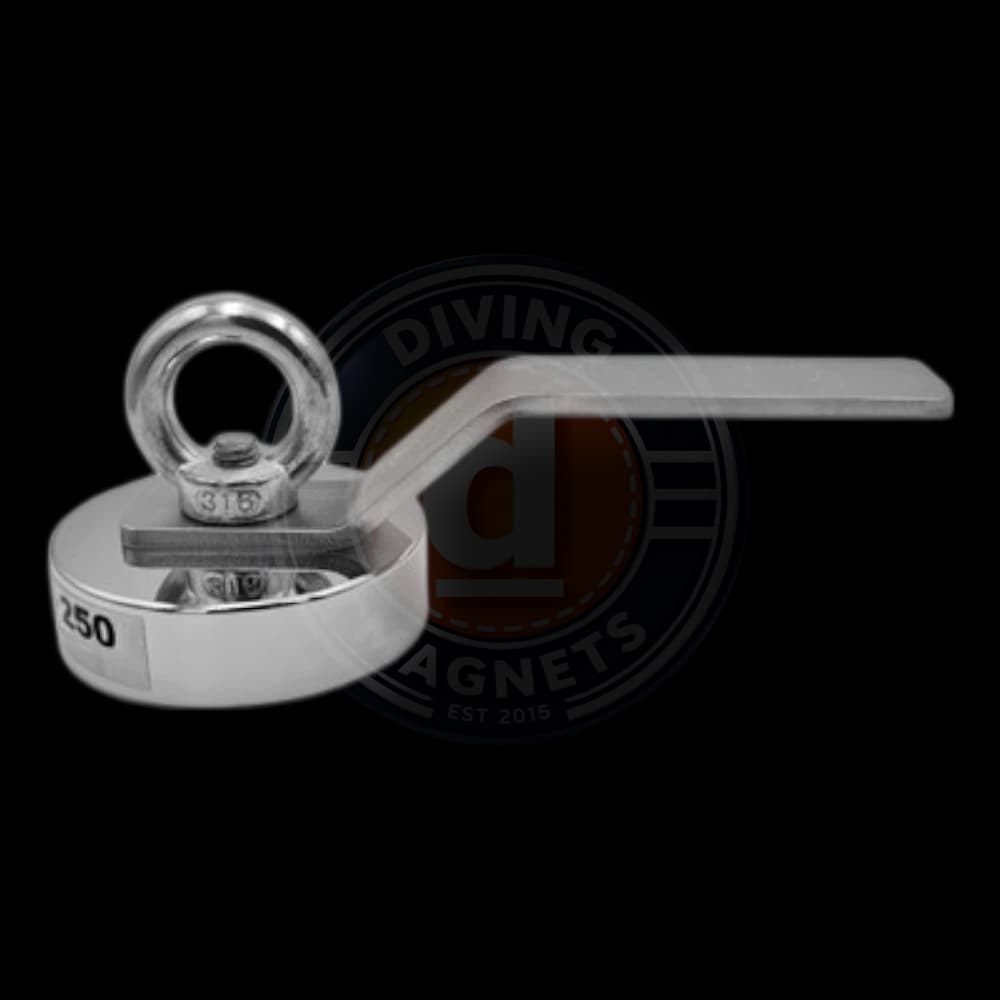
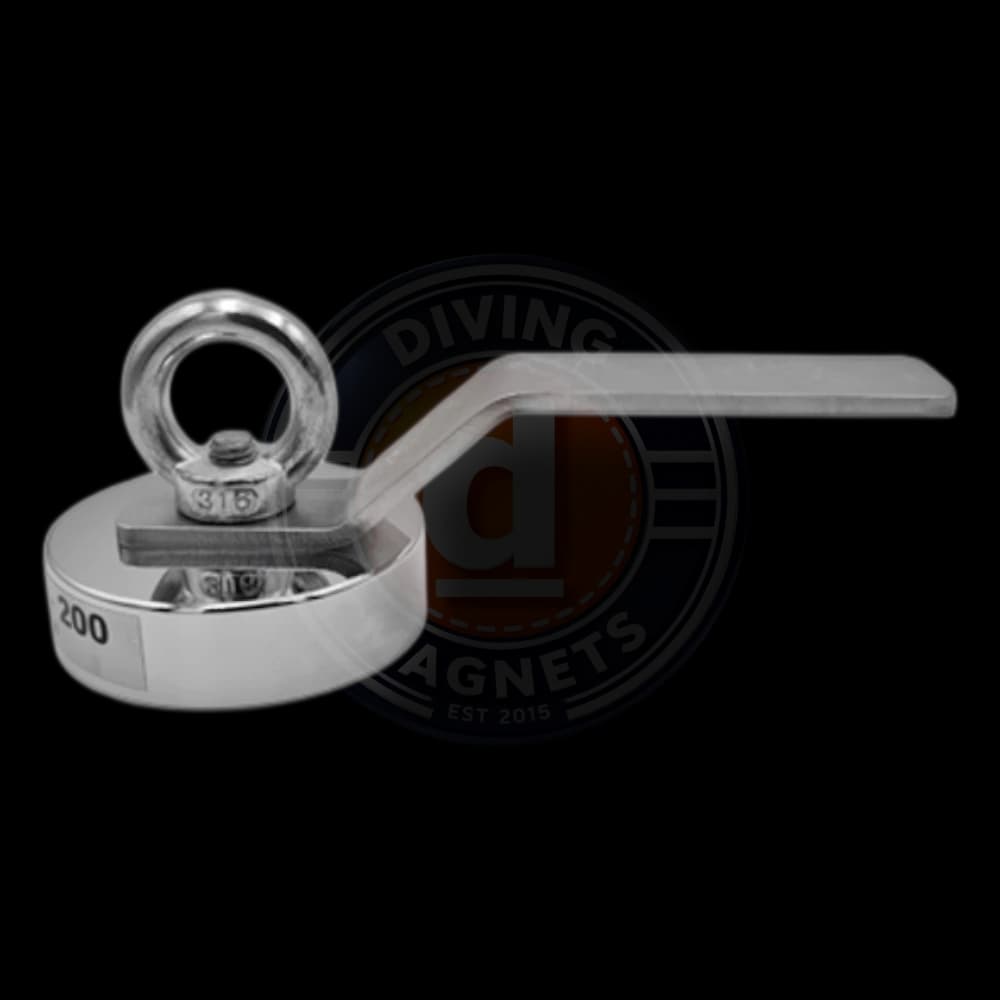
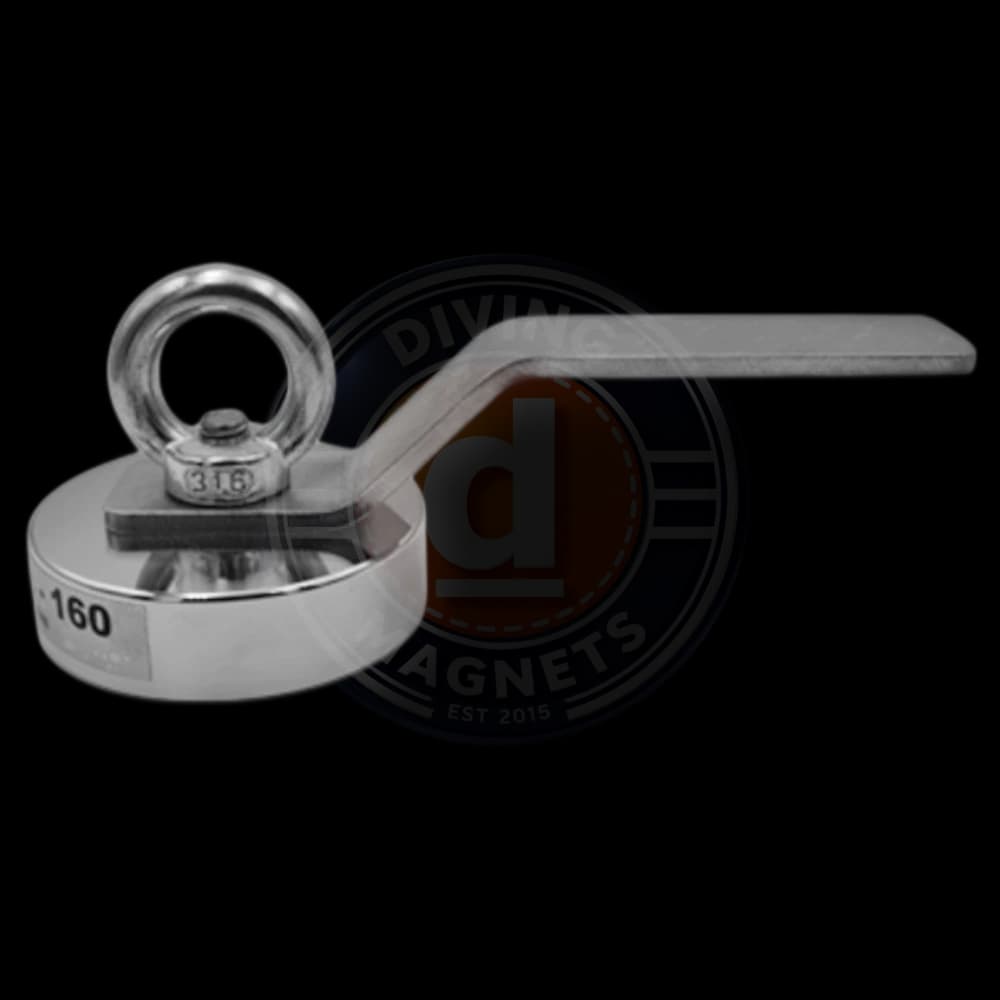
A diving magnet is a powerful, sealed neodymium magnet with a handle that a commercial diver places on steel underwater to get a temporary anchor point. It holds the diver in position, or holds tools and lines, on ship hulls, offshore structures, pipelines and steel gates, and comes off again by hand.
Divers also call it a diver magnet or a subsea magnet. We call ours magnetic subsea anchor points.
How a diving magnet works
A diving magnet works like a small pot magnet built for salt water and hard use:
- The magnet: a high-grade N42–N48 neodymium ring magnet.
- The seal: the magnet is coated in epoxy (about 20 µm), then covered in HDPE plastic (about 200 µm), so salt water never reaches the neodymium. We call this Epoxy-HDPE sealing.
- The steel pot: the sealed magnet sits in a plated carbon-steel pot. The pot focuses the magnetic field on the face, which is where the holding force comes from.
- The handle and eye nut: a 316 stainless steel handle and eye nut, so the diver can grip it, clip a lanyard to it, or tether a tool.
You place the face flat on clean steel and it holds. To release it, you tilt it off the edge rather than pulling it straight off.
What divers use a diving magnet for
- Holding position on a ship hull during UWILD and class surveys, thickness gauging, cathodic protection (CP) readings, hull cleaning and propeller polishing. On a survey you swim along the hull with a magnet in each hand.
- Working in one spot with tools attached, where a heavier magnet keeps you steady.
- Offshore structures and pipelines: jacket legs, braces and members, risers and piles, holding tool bags and guide lines.
- Dams, intakes and steel gates: trash racks, penstocks, stoplogs and sluice gates.
Single and twin diving magnets
Our diving magnets come in five single sizes and five twins, from 115 kg to 500 kg rated pull force:
| Type | Models | Notes |
|---|---|---|
| Single | Diver Magnet 115, 140, 160, 200, 250 | One magnet, one handle |
| Twin | Diver Magnet 230, 280, 320, 400, 500 | Two magnets on one handle (230 = 2 × 115, 280 = 2 × 140, 320 = 2 × 160, 400 = 2 × 200, 500 = 2 × 250) |
Which size of diving magnet do you need?
From our own field work:
- Swimming a hull survey: two Diver Magnet 140s, one in each hand. They are stable but let go easily as you move.
- Hull work in one place with tools attached: the Diver Magnet 200 or 250. The 250 is our best seller.
- Risers (8–12 inch) and vertical members: the twin 230 or 280. Set the twin in line along the pipe, not across it, so the curve doesn't spoil the contact.
- Larger pipes and risers above 12 inch: a bigger twin, because a bigger pipe has less curve and the larger magnets get full contact.
For blanks and cofferdams on hulls, see the sizing table in How to choose the right diving magnet.
Rated pull force and real holding force
The rated pull force is measured on clean, thick, flat steel with the magnet pulled straight off. Underwater the real hold is lower. Paint, marine growth, rust, gaps, thin plate and side-loading all reduce it. That is why we say: choose a magnet rated at least 2–3 times the load you need it to hold. More in Magnet pull force explained.
Safe use of a diving magnet
- Not for lifting. A diving magnet is a positioning and holding tool, not lifting equipment. Never lift, rig or suspend a load from it.
- Mind your fingers. Two magnets, or a magnet and steel, snap together hard.
- Never machine, cut, drill or grind a magnet.
- Temperature: use up to 80 °C.
- Keep it clean: rinse in fresh water after the dive.
Full list: Neodymium magnet safety underwater: 5 rules.
Diving magnet vs pot magnet vs hook magnet
Only diving magnets are built for subsea use. Pot and hook magnets are nickel coated. Underwater the nickel chips easily (one knock from a barnacle can take it off), and once the magnet is exposed the corrosion cannot be undone. That is why our pot and hook magnets are marked dry use only. More in Diving magnet vs pot magnet: which to use?.
About Diving Magnets
Founded in 2015 in Gordon's Bay, South Africa, Diving Magnets builds magnetic subsea anchor points for commercial divers. Our diving magnets are proven to 150 m and used by dive contractors in more than 40 countries. Shop the range · Compare models · How much does a diving magnet cost?
Common questions
What is a diving magnet used for?
To give a commercial diver a temporary anchor point on steel: holding position on a ship hull or offshore structure, or holding tools, tool bags and guide lines while working.
How strong is a diving magnet?
Ours are rated from 115 kg to 500 kg pull force. The real hold underwater is lower than the rating, so pick a magnet rated at least 2–3 times the load.
Can a diving magnet be used for lifting?
No. A diving magnet is a positioning and holding tool, not lifting equipment.
How deep can a diving magnet be used?
Our diving magnets are sealed in Epoxy-HDPE and proven in service to 150 m.
Does a diving magnet rust?
The neodymium is sealed in epoxy and HDPE, and the handle, eye nut and screws are 316 stainless steel. Rinse it in fresh water after each dive.
Do diving magnets work on aluminium or stainless steel hulls?
They hold on magnetic steel. Aluminium is not magnetic, and most austenitic stainless steels (such as 316) hold weakly or not at all.